
Elizabeth de Jesús | On the stone skins of rooms in the past
Elizabeth de Jesús on the words of Ruppe Koselleck
by Ruppe Koselleck
INTRODUCTION by Nuria Richards
In Mexico, like in many countries in Latin America houses lean to each other, transferring information into the memory of the next building.
Reading the signs of the layout of a space in this way allows me to push to and use the German approach to the concept of spirit, the Geist. In a very Hegelian manner, de Jesús paintings refer to an observation that translates an architectural spirit, with violent signs left in the form of solutions that show as scared walls.
The price for renewing the cityscape comes for the community with a lost of continuity, a desire to read the past of habitated spaces, and rubble.
Clandestina has defined herself from the very beginning as a place to explore the Contemporary Geist. Cultural immigration and exchange allows presenting the contrast of details through the research of the artists.
The Im Baum paintings are linked to a research of photographic nature of urban remains. The following article by Ruppe Koselleck elaborates on the elements that are translated into the paintings and represent the core of the series.
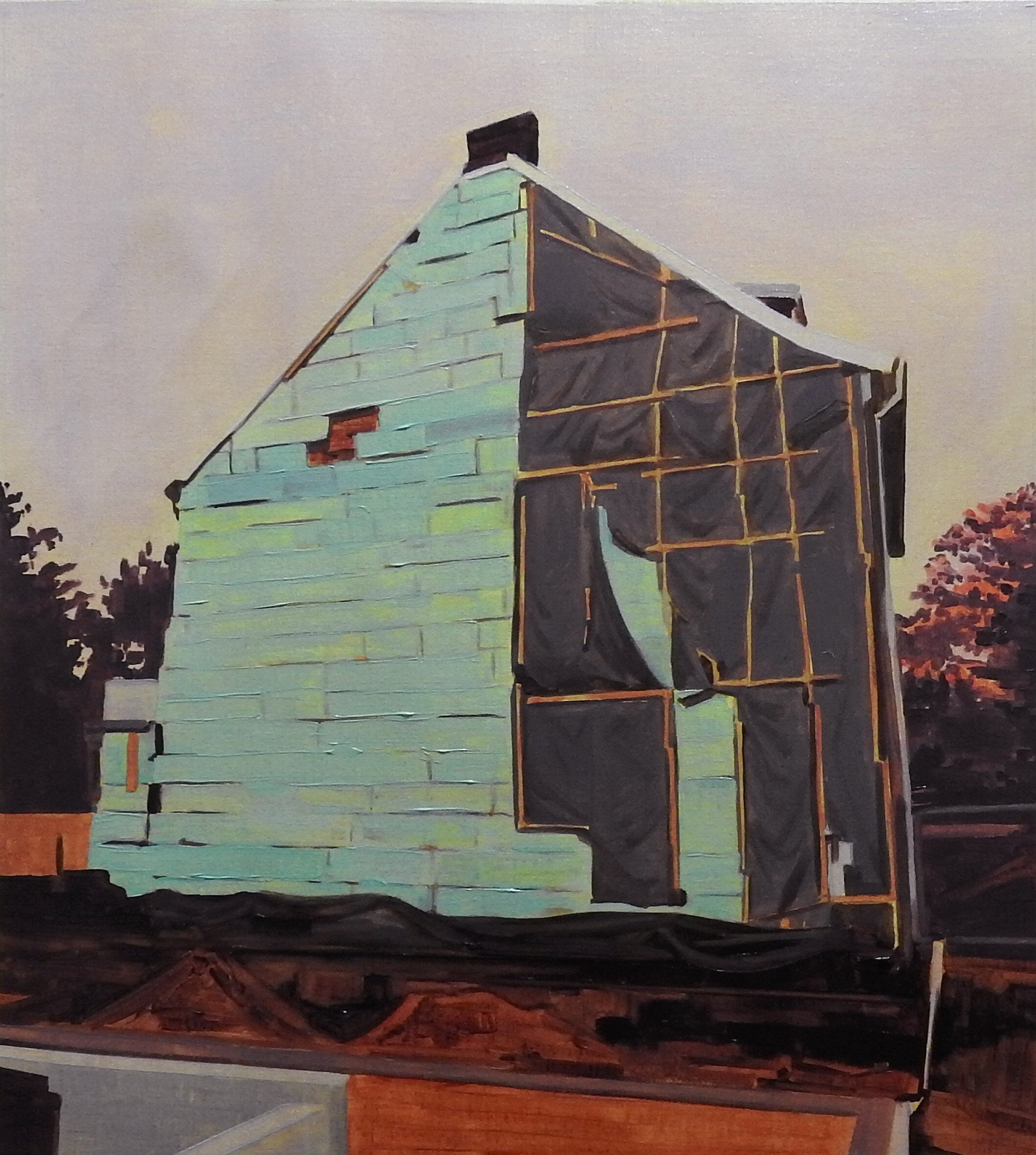
Elizabeth de Jesús | Im Bau | 2020
On the stone skins of rooms in the pastIn the context of #underconstructions - a collaboration and exchange between Mexican and German artists - Elizabeth de Jesús extended her search on PHANTOM HOUSES: a photographic collection of demolished houses, which left traces in the adjacent walls, ghost like (spirits). Between Essen, Ahlen, and Münster she investigated traces of past architecture as well as relics of demolished houses.
The artist found what remained, obvious references to missing rooms in the permanent firewalls, where the buildings touched each other. These architectural observations deal with the walls as the skins that separate the interior from the exterior.
And as we move along the tiled walls of a bathroom from the past, we glimpse the private sphere and the traces of people; people who brushed their teeth there become evident
Her architectural studies are, therefore, contemporary documents of the presence of the absent.
The destroyed staircase, on which they will no longer descend bare, leaves a staggered sculpture on the wall. The interior plastering of the bedroom, now turned from the inside out, speaks of the past tastes of the absentees, the grease stains place the dinning room, and the painting of the corridor without the care that the previous tenants had.
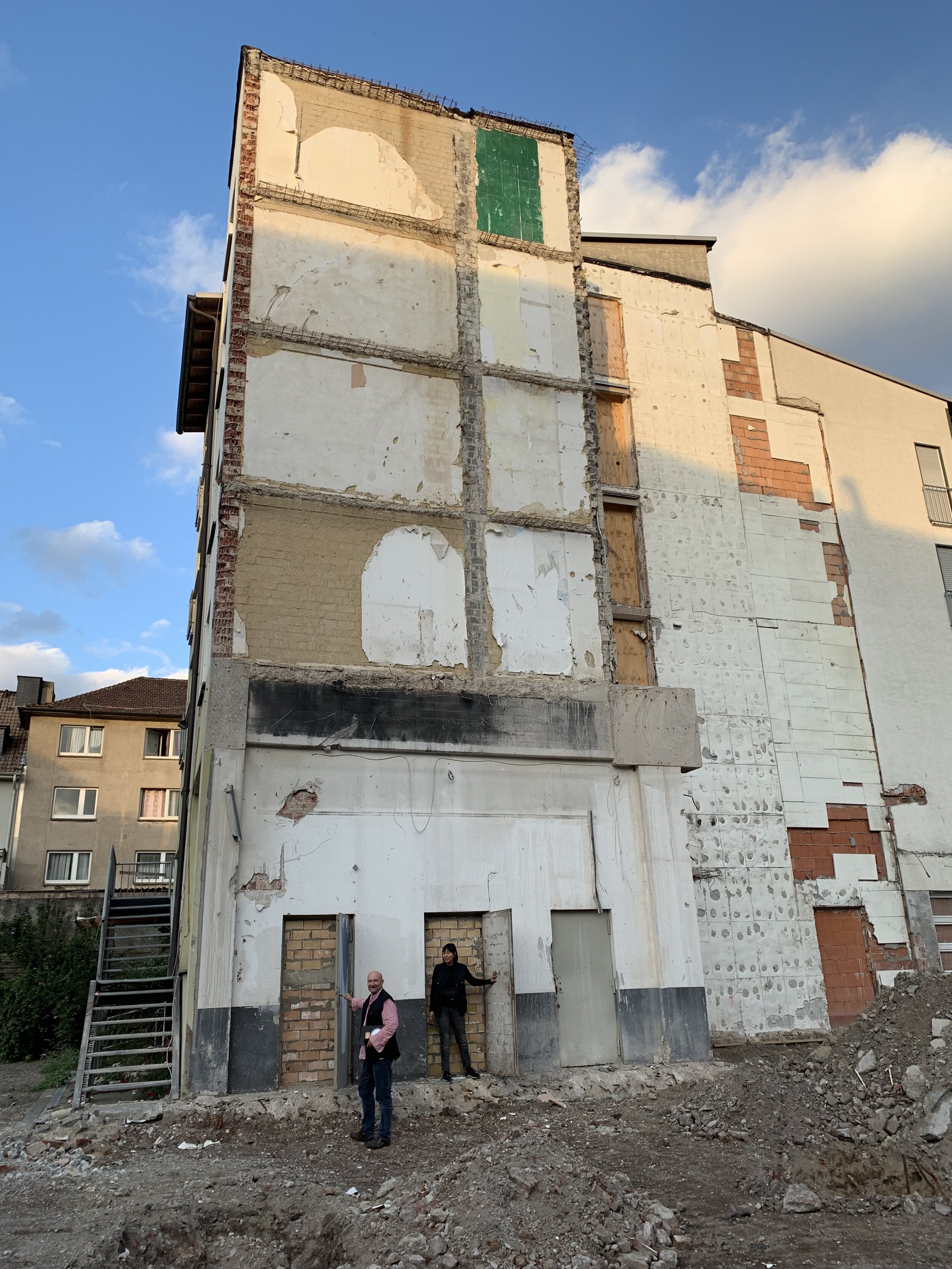
Cornerstone | Photographic archive | Courtesy of the artist
The photographs in this collection are, therefore, intimate witnesses to the private history of walls now facing the public space and, as an ephemeral element, they also represent the everyday narratives written about the day-to-day history of humanity.
When the interior becomes the exterior, the aesthetic references about the private and the public space are reversed. The remains of wallpaper are publicly perceived as décollage, installation or mural, and can be interpreted as family portraits, photos of shared flats or single dwellings.
Every morning, the mirror left for the morning bath threw out its unshaven, unmade truth to the inhabitants and now hangs uselessly on the wall at a height of five meters, reflecting white clouds in the blue sky.
The fragile security of human dwellings is visible in their striking and dilapidated precariousness, so the house that remains has become a monument to the home that is gone - for a short time, until a new one takes over.
Elizabeth de Jesus transforms a number of ghost houses into paintings with her Cornerstone series, in which light and colour turn the rooms of the past into abstract forms and reflections on the surface.
At the construction site, the cornerstone is understood as the angle or keystone to which the supporting columns refer and calculate, in the work of Elizabeth de Jesús, this stone becomes the end and the starting point of the process of closure and permanent renewal of historicity.

Cornerstone | Photographic archive | Courtesy of the artist
It is of central importance that in no case people become visible in her paintings; instead references and abstract allusions to existence are enough clue to allow the viewer the greatest possible freedom of post-narrative projection.
The eternal cornerstone spirits of the walls are shown as on the walls of sunken cities. Not only are they accumulating, but also they come from the past.
The transformed photographs and paintings create an archive of temporary stone skins at the limits of architectural space, of this eternally fragile, everlasting hope, on a space which provisional consumption has been accelerated by steel and concrete.
The artist understands how to capture a wounded space through its outer skin, lending it a new and wonderful present for the durability of the canvas.
About Ruppe Koselleck
Ruppe is an Artist, Academic, Curator and Director of the Kunstverein Ahlen in Germany. He is also a co-founder of the Mexico-Germany Art Bureau “Underconstructions”.

From the mute silence to the glimpse of light
Amor Muñoz on the words of Adriana Sandoval
The Conlon Nancarrow & Juan O’Gorman house and studio in dialogue with artist Amor Muñoz. By Adriana Sandoval
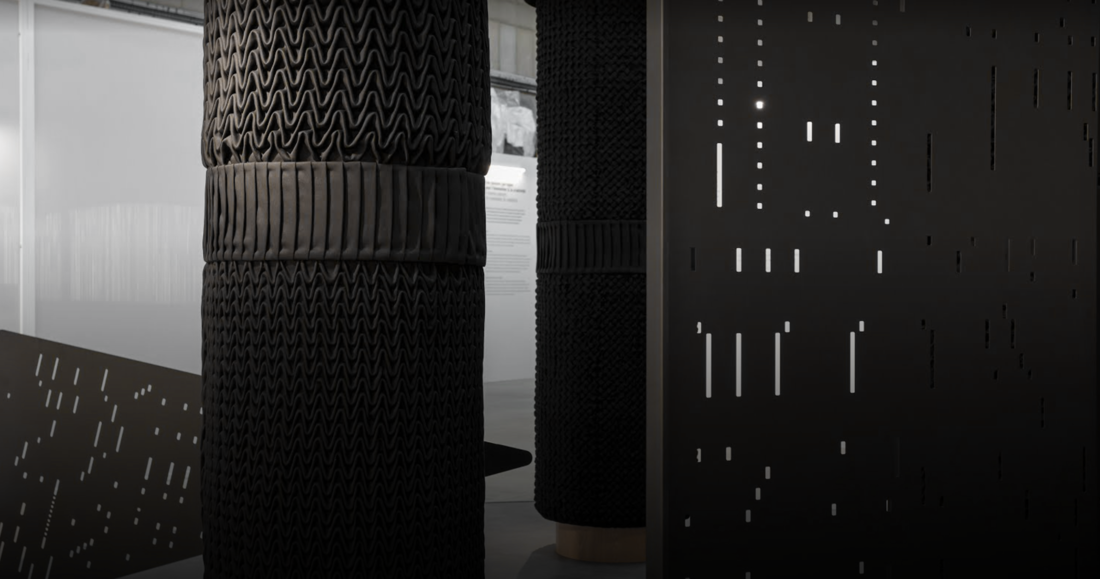
Notes and Folds by Amor Muñoz
The house and studio of Mexican-American musician Conlon Nancarrow (1912-1997) is located in the southwest of Mexico City. The Nancarrow house shelters the laboratory in which Conlon Nancarrow produced a large portion of his compositions. The flow of the space represents what is known as the “organic constructions” of architect Juan O’Gorman (1905-1982).
Conlon Nancarrow is considered one the most exceptional composers of the 20th century at the same time Juan O’Gorman is without doubt a prominent representative of Latin-American architecture in that same time period.
The Conlon Nancarrow house and studio is an architectural structure-manifest that testifies, foot by foot and in an irreplaceable way an everlasting geniality on conceiving architectural spaces considering the materialization of particular solutions put in place by Juan O’Groman who designed the studio for a man that he considered one of his most beloved friends.
From the point of view of Art History and Architecture, the Conlon-Nancarrow house represents what O’Gorman believe to be the definition of a residential alternative in contrast to the domestic vertical architecture that boomed in Latin American after WWII. For O’Gorman the organic nature of architecture is represented by an environment that integrates elements of landscape, put together with the materials sourced locally and organized with a clear intention of confronting the industrial world; organic buildings that could bond men and nature.
Letting the senses to be triggered by the atmosphere of the Nancarrow space is a chance to relate with the day-by-day of almost fifty years of the composer’s life. Between the studio chamber and the terrace, library and kitchen, and the relationship between bedroom and garden, one can only imagine silence, light, and wind keeping company to the composer, a combination of elements that comforted him and became part of his creative process. The development that O’Gorman built for the Nancarrow is particular at a level that its core is not possible to neither be transferred nor replaced.

Espacio Nancarrow O'Groman | Photo by Daniel Orozco
Amor Muñoz at Espacio Nancarrow – O’Gorman
Mexican born artist Amor Muñoz is the first artist in residency at Conlon Nancarrow house and studio a project sponsored by the Espacio Nancarrow – O’Gorman Foundation. The outcome of her project has become of significant value for the non-profit organization and for the artist who after her months of research at the space established the project Notes & Folds in collaboration with Google Arts & Culture.
In interview with Amor Muñoz, the artist highlighted the perception she has on the relevance that the texture of light in the architecture of Juan O’Gorman had for Conlon Nancarrow. Now, further down the road in her artist residency Muñoz refers to this element as a resource to decode the gesture that the house and studio have for her.
Muñoz has become influenced by the intellectual character of the production of Conlon Nancarow and his own practice as maker, as a reference to the Maker Culture that is a essential on the technology-based production of the artist, an element that linked Nancarrow and Muñoz’ dialogue.
Amor Muñoz artist residency at Conlon Nancarrow house and studio comes to extend the perception of music from vibration to a tactile body of work, carrying the structure of player piano scores of paper rolls to pleaded coded textiles.
Clandestina presented a solo booth by artist Amor Muñoz at Untitled, Art San Francisco on January 2020 in collaboration with Espacio Nancarrow-O’Gorman, and the show PATTERNS at its space in Miami in February 2020. PATTERNS as well as RHYTHMIC MANUFACTURE an online special based on the drawings made by the artist for the homonym performance.
www.clandestina.art
About Adriana Sandoval
Adriana is an Academic, Curator and Researcher specialized in the work of Juan O’Gorman. She is also a co-founder of the non-for profit organization Espacio Nancarrow-O’Gorman.
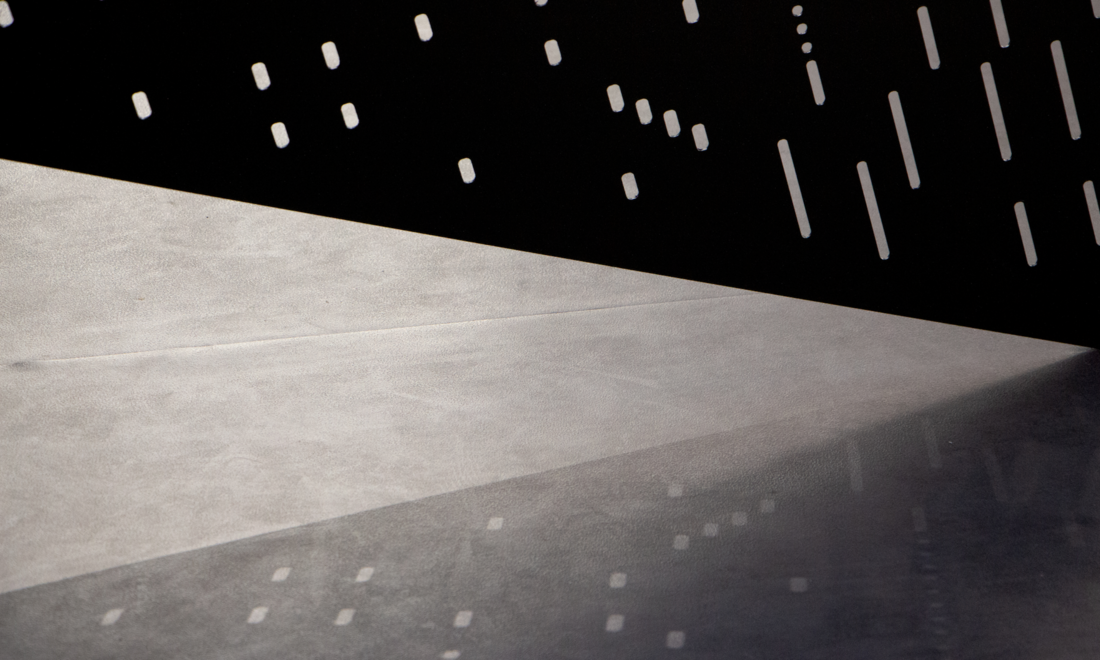
Notes and Folds by Amor Muñoz
CURATOR
Curators reflect on the work and process of artists on view.